That’s classical probability for you.
Statistical probability, on the other hand, is always 0% for things never happened before.
I have a hunch those working in the field (of probability calculations, not changelings) have some other formulas, which might give a better esrimate than 50% or 0%. But I have no time for such so I’m gonna keep (mis)using whichever gives me the chances I like the most!
The one that got me thinking is: “You rent a hotel room and find that the ceiling is leaking. They move you to a second room, and the ceiling there also turns out to be leaking. Would you take your chances on getting moved to a third room?”
IIRC that’s Bayesian reasoning? Basically, you take into account the fact that a causal factor leading to X1 and X2 is also likely to lead to X3, so while some types of statistics would consider the chances of X1 and X2 independently (e.g. 1% chance of any given ceiling leaking, so 0.01% chance of *two* ceilings leaking, and the chance of *three* would be 0.0001%), this type of reasoning says “Hang on, if you’ve found two leaking ceilings already, then whatever caused the problem is likely to be affecting even *more* ceilings in this area.”
Similarly: “Once is happenstance, twice is a coincidence, thrice is enemy action.” Or “One kid with this super rare disease could be anywhere, but two in the same area means we should check out possible causal factors before we start creating more.” Or “The last three boyfriends I’ve dated have been seriously bad choices; why don’t I try to figure out what common factors exist (in them or in my process of choice) before I attempt a fourth?”
An interesting question. On one hand, if two different rooms in the same hotel have leaking roofs, it suggests some seriously bad maintainance on the hotel’s part, which increases the chance that other rooms might also have leaks. On the other hand, even in a hotel with atrociously bad maintainance, it seems unlikely that every single room would have sprung a leak, unless the roof was recently damaged by a hailstorm or the like.
If the hotel has multiple floors, I could try to ask to be relocated to a different one 🙂
Receptionist: “There’s one room available on the floor above you but it says here the faucet got jammed open last week and the sink is missing. So, you don’t mind that?”
I actually have a sort of shapeshifter fic currently on hiatus. Harold Finch got kidnapped and the kidnapper turned out to be able to move into new bodies, so he’s taken over Finch’s body (destroying his previous host) and Finch is trapped inside his own head.
When eventually I get back to writing it, I’ll be having a fun Outsider Perspective as the bodysnatcher gets pulled into the team, uses Finch’s mind to pass various tests, and slowly comes to believe in their cause more than his own welfare. Not sure where I’m gonna go with it but I do want a happy ending somehow (for Finch, at least).
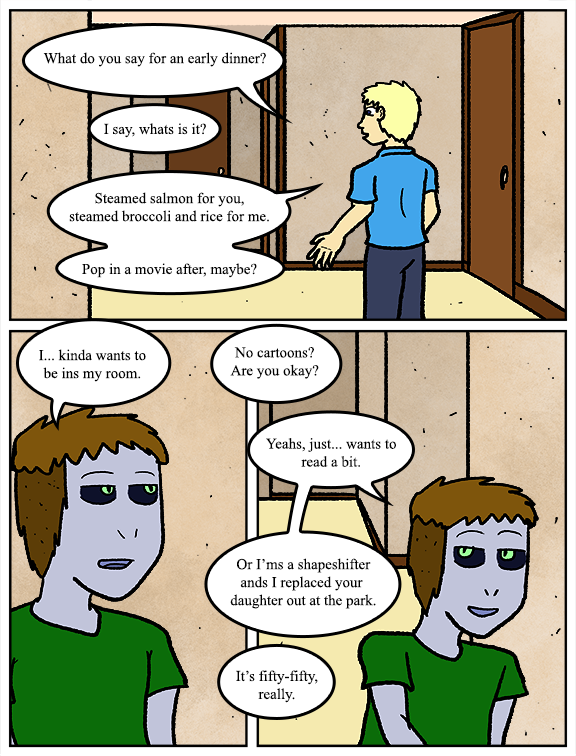





That’s classical probability for you.
Statistical probability, on the other hand, is always 0% for things never happened before.
I have a hunch those working in the field (of probability calculations, not changelings) have some other formulas, which might give a better esrimate than 50% or 0%. But I have no time for such so I’m gonna keep (mis)using whichever gives me the chances I like the most!
The one that got me thinking is: “You rent a hotel room and find that the ceiling is leaking. They move you to a second room, and the ceiling there also turns out to be leaking. Would you take your chances on getting moved to a third room?”
IIRC that’s Bayesian reasoning? Basically, you take into account the fact that a causal factor leading to X1 and X2 is also likely to lead to X3, so while some types of statistics would consider the chances of X1 and X2 independently (e.g. 1% chance of any given ceiling leaking, so 0.01% chance of *two* ceilings leaking, and the chance of *three* would be 0.0001%), this type of reasoning says “Hang on, if you’ve found two leaking ceilings already, then whatever caused the problem is likely to be affecting even *more* ceilings in this area.”
Similarly: “Once is happenstance, twice is a coincidence, thrice is enemy action.” Or “One kid with this super rare disease could be anywhere, but two in the same area means we should check out possible causal factors before we start creating more.” Or “The last three boyfriends I’ve dated have been seriously bad choices; why don’t I try to figure out what common factors exist (in them or in my process of choice) before I attempt a fourth?”
An interesting question. On one hand, if two different rooms in the same hotel have leaking roofs, it suggests some seriously bad maintainance on the hotel’s part, which increases the chance that other rooms might also have leaks. On the other hand, even in a hotel with atrociously bad maintainance, it seems unlikely that every single room would have sprung a leak, unless the roof was recently damaged by a hailstorm or the like.
If the hotel has multiple floors, I could try to ask to be relocated to a different one 🙂
Receptionist: “There’s one room available on the floor above you but it says here the faucet got jammed open last week and the sink is missing. So, you don’t mind that?”
A smart shapeshifter wouldn’t go near someone like Selkie. Too damn observant and clever; i.e., like your own kind.
That’s exactly why you replace the most observant people first.
I’ll have to remember this when I GM.
I actually have a sort of shapeshifter fic currently on hiatus. Harold Finch got kidnapped and the kidnapper turned out to be able to move into new bodies, so he’s taken over Finch’s body (destroying his previous host) and Finch is trapped inside his own head.
When eventually I get back to writing it, I’ll be having a fun Outsider Perspective as the bodysnatcher gets pulled into the team, uses Finch’s mind to pass various tests, and slowly comes to believe in their cause more than his own welfare. Not sure where I’m gonna go with it but I do want a happy ending somehow (for Finch, at least).
I love how Todd just rolls with it in this interaction. <3
Their relationship is a beautiful thing.
i swear someone needs to enter selfie in a DND campaign