I think the most important factor is whether the kid cares about the stuff they learned or not. I probably gained more learning on my own than lost, the nerd I was (and am), e.g. by watching every nature documentary they showed on TV.
The school recommended it for mine (not for academics, but for the routine). She definitely learned more at home over the summer than at summer school, but since she had like an hour bus ride each way, she got important practice in other lifeskills, which I think was worth it. Would do it again.
She loved summer school, but only tolerated my home assignments because the computer and outdoor playing were both gated behind them (and it seriously took her 30 minutes, tops, if she didn’t waste time complaining, so it’s not like it ruined her summer). Read a short book and write four sentences about it; do a little Khan Academy math. Occasionally some science and practical skills woven in.
The real problem is that most of those other kids aren’t maintaining skills over the summer, so review is sort of baked into lesson plans. So if your kid is already ahead, they’re just going to end up even more ahead.
When it comes to facts, the most important thing I learned in school was a skill: how to find the information I needed. Once you use something a few times, you’ll naturally memorize it.
Skills, however, need regular practice to stay current.
Even as a kid, I was like, “But what if I just kept a calculator in my pocket?”
“Well, it wouldn’t always be convenient.”
“But aren’t some called pocket calculators?”
I did fine in math, but it still seemed to me that if you weren’t and often needed to multiply, the solution was right there.
(I do think there were actual advantages to doing the things that teachers said “you won’t always have a calculator” to explain the point of doing. But the calculator thing was a weak argument.)
I read a science fiction story, many many years back. I think it was Arthur Clarke, but it’s been so long ago I’m not sure.
The plot of the story was it they had found a man that could do math without a calculator. You give him numbers and a pencil and paper and he could give you an answer. He could add, he could subtract. He could multiply and divide. Those last two took longer but he could do it. The whole town was amazed.
My friends and I were never tasked to memorize molecular weights in chemistry but after checking them over and over again enough times, we started to learn them by heart and didn’t have to check anymore. So, even if no math was taught i schools, there’s going to be people who just memorize enough calculations that they can do basic math simply by chaining the memorized calculations, I think.
And if they are curious enough, they’ll start looking for patterns and use them to predict calculations they have never seen the answers to. Not to brag but I, for instance, managed to solve differential math problems year before I even knew what it was simply by playing with my graphical calculator. I mean, the method I came up with was clumsy and had no proof beyond graphs looking close enough, but it still kinda worked.
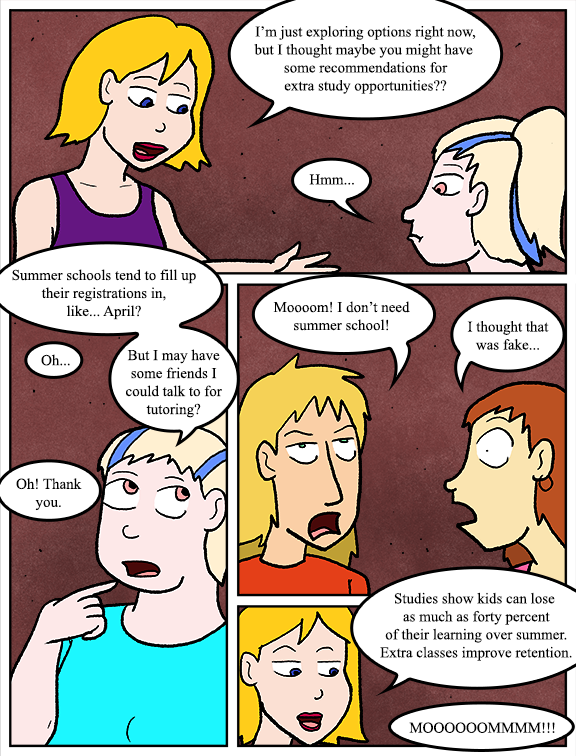
Unless the grades warrant it I think summer school is a pretty good way to alienate a kid.
I know as a kid my Mother would have had to drag me there and keep me there under lock and key, there’s no way I’d willingly go to Summer school just cause.





I think the most important factor is whether the kid cares about the stuff they learned or not. I probably gained more learning on my own than lost, the nerd I was (and am), e.g. by watching every nature documentary they showed on TV.
The school recommended it for mine (not for academics, but for the routine). She definitely learned more at home over the summer than at summer school, but since she had like an hour bus ride each way, she got important practice in other lifeskills, which I think was worth it. Would do it again.
She loved summer school, but only tolerated my home assignments because the computer and outdoor playing were both gated behind them (and it seriously took her 30 minutes, tops, if she didn’t waste time complaining, so it’s not like it ruined her summer). Read a short book and write four sentences about it; do a little Khan Academy math. Occasionally some science and practical skills woven in.
The real problem is that most of those other kids aren’t maintaining skills over the summer, so review is sort of baked into lesson plans. So if your kid is already ahead, they’re just going to end up even more ahead.
How many adults learn things just long enough to solve their current problem? If you learn how to learn, it wasn’t entirely wasted effort.
Facts or skills?
When it comes to facts, the most important thing I learned in school was a skill: how to find the information I needed. Once you use something a few times, you’ll naturally memorize it.
Skills, however, need regular practice to stay current.
“I used to retain History class info exactly long enough to pass the exams and that was it. Afterwards? Poof, gone.”
Those who do not remember history are doomed to repeat it.
Much as I agree with the sentiment I feel like it applies to relatively little of what most kids learn in history class.
I’m still salty over the math teachers telling me I won’t always have a calculator in my pocket, when i’m here typing this on my iphone.
Even as a kid, I was like, “But what if I just kept a calculator in my pocket?”
“Well, it wouldn’t always be convenient.”
“But aren’t some called pocket calculators?”
I did fine in math, but it still seemed to me that if you weren’t and often needed to multiply, the solution was right there.
(I do think there were actual advantages to doing the things that teachers said “you won’t always have a calculator” to explain the point of doing. But the calculator thing was a weak argument.)
I read a science fiction story, many many years back. I think it was Arthur Clarke, but it’s been so long ago I’m not sure.
The plot of the story was it they had found a man that could do math without a calculator. You give him numbers and a pencil and paper and he could give you an answer. He could add, he could subtract. He could multiply and divide. Those last two took longer but he could do it. The whole town was amazed.
My friends and I were never tasked to memorize molecular weights in chemistry but after checking them over and over again enough times, we started to learn them by heart and didn’t have to check anymore. So, even if no math was taught i schools, there’s going to be people who just memorize enough calculations that they can do basic math simply by chaining the memorized calculations, I think.
And if they are curious enough, they’ll start looking for patterns and use them to predict calculations they have never seen the answers to. Not to brag but I, for instance, managed to solve differential math problems year before I even knew what it was simply by playing with my graphical calculator. I mean, the method I came up with was clumsy and had no proof beyond graphs looking close enough, but it still kinda worked.
I would run away if my parents did that to me, burning the house down before I went.
Oh thank goodness, I thought that she was doing poorly in school.
So true. Most educators estimate the entire month of September is used up just catching the kids up to the level they left at in June.
I’m much in favour of summer learning… admittedly because I am long out of school. 😅
Unless the grades warrant it I think summer school is a pretty good way to alienate a kid.
I know as a kid my Mother would have had to drag me there and keep me there under lock and key, there’s no way I’d willingly go to Summer school just cause.
ok but can we talk more about table flipper