You chose just about the worst examples you could possibly have chosen. There is sand along the rivers in Alaska. Eskimos/Inuit would certainly know about it and have a word for it. And it does snow occasionally in Hawaii, therefore there is almost certainly a Hawaiian word for it.
Normally food is something you can find an equivalent for, like hamburgers coming to Japan, or chocolate in many countries.
Other things might be harder to track due to how long ago they were introduced and a lack of records surviving. Telephone and internet might be the latest technology transfer in that sense.
Yes, both those cultures have words for those environmental objects.
And it makes perfect sense for tensei to have a word for climb. They can leave the water. They have legs. And there are going to be situations where they need to climb rather than swim. Bad currents around narrow crevices come to mind.
But Selkie specifically grew up in a pond before she came to the orphanage. The word for what described the act of ‘using your hands and feet to clamber out of the crevasse you got yourself stuck in and back into freer water’ wasn’t one SHE had ever needed to learn.
It could also be something they use for actions of certain animals. But it makes sense for it to be a linguistic gap for a child tensei speaker– which is also funny because for many human children, “climbing” is a favorite activity.
Interestingly, it can be hard to find an area that is both isolated enough from other cultures to not learn things from them (ie loanwords) and do not have a mountainous region that creates snow. It is difficult for cultutlres that do not have more “common” geographical and natural things (for which to generate the words from) and also to have records survive long enough to record the interaction, or have a culture so isolated that the reaction is more recent (so doesn’t have to survive as long). It is easier to see with more localized objects (such as plants or animals) or man made objects (tools, food, etc).
There are notes that ancient egyptians using a Semitic loanword, so they learned about it through other cultures. On the other hand, the Kiribati islands did not have a word for “mountain” due to their islands being flatter. Reference: “One difficulty in translating the Bible was references to words such as “mountain”, a geographical phenomenon unknown to the people of the islands of Kiribati at the time, heard only in the myths from Samoa. Bingham substituted “hilly”, which would be more easily understood.”
I would expect that tensei would have more trouble with “air” related concepts, though they would still be exposed to it some with the surface. Some of that would also depend on education level and interest, as you even get humans that can’t tell general flowers or plants apart since it isn’t required for their daily life. I’m not sure how much the general Sarnothi public would have to deal with mist or tornadoes. It would still be more likely that those words would exist compared to more localized thing, animals, or plants, like elephants. Volcanoes would be one thing I don’t think they would know about, as there would be no reason for them to have encountered one.
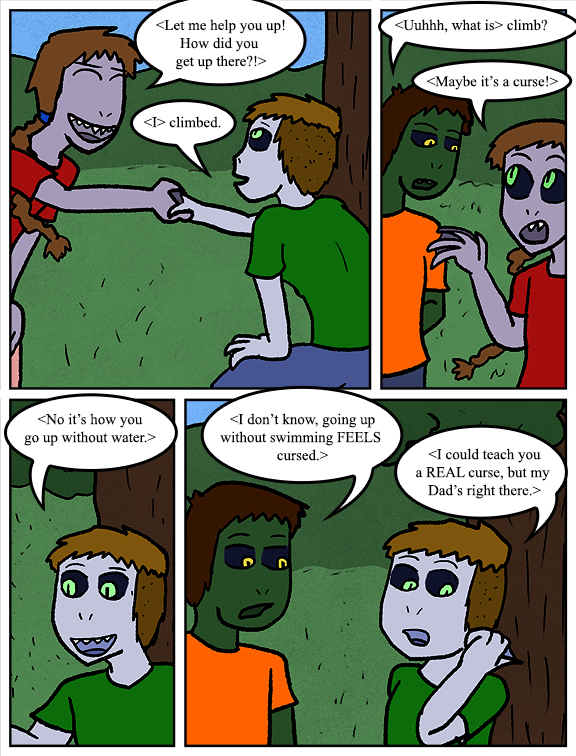
This is one of my favorite pages, mainly because it’s nice to see Selkie making friends easily, as compared with her early days in the orphanage, but also because it’s cute and funny that the other kids don’t know what climbing is.
But it bothers me a little that these raised-underwater kids are so freaked out at the thought of moving upward without swimming. If they are now living on the surface, they certainly know how to get out of bed, and they probably have experienced staircases. The trouble is that Selkie’s definition of “climb” is too broad; I can well imagine that the other kids have never climbed a tree, or climbed a hill.
Although you can “climb” a staircase or a hill in the sense of going up, in practice the slopes are gentle enough that you can do so using pretty much the same motions as normal walking. Climbing a tree, by contrast, is a more complicated activity using all four of your limbs, and you’re not automatically good at it because you’re good at walking.
So yeah, technically they’ve probably “gone up without swimming” at some point, but it makes sense that they’d still be confused how that can apply to a tree.
The wording can be chalked up to them (A) not being familiar enough with the concepts to express exactly what they mean, and (B) them deliberately exaggerating their response as in-universe joke. I mean, are you going to say Selkie is dumb for mixing up two different meanings of the word “curse”? No, she’s aware of both meanings of the word, she’s just joking. Likewise, the new kids clearly aren’t worried enough about the “curse” to run screaming or pray for an exorcism, so I doubt they’re entirely serious.
(As for whether sarnothi would have ever encountered something like that before: they’ve probably at least seen waterbirds taking off. That’s going up without swimming, but not climbing…)





It would make sense that there isn’t a tensei word for climbing.
Possible there is, but Selkie doesn’t know it. Are some obscure words in English people don’t know.
Why would they? Do you suppose Eskimos have a word for sand? Or maybe there is a word for snow in Hawaiian?
You chose just about the worst examples you could possibly have chosen. There is sand along the rivers in Alaska. Eskimos/Inuit would certainly know about it and have a word for it. And it does snow occasionally in Hawaii, therefore there is almost certainly a Hawaiian word for it.
Normally food is something you can find an equivalent for, like hamburgers coming to Japan, or chocolate in many countries.
Other things might be harder to track due to how long ago they were introduced and a lack of records surviving. Telephone and internet might be the latest technology transfer in that sense.
Yes, both those cultures have words for those environmental objects.
And it makes perfect sense for tensei to have a word for climb. They can leave the water. They have legs. And there are going to be situations where they need to climb rather than swim. Bad currents around narrow crevices come to mind.
But Selkie specifically grew up in a pond before she came to the orphanage. The word for what described the act of ‘using your hands and feet to clamber out of the crevasse you got yourself stuck in and back into freer water’ wasn’t one SHE had ever needed to learn.
It could also be something they use for actions of certain animals. But it makes sense for it to be a linguistic gap for a child tensei speaker– which is also funny because for many human children, “climbing” is a favorite activity.
Interestingly, it can be hard to find an area that is both isolated enough from other cultures to not learn things from them (ie loanwords) and do not have a mountainous region that creates snow. It is difficult for cultutlres that do not have more “common” geographical and natural things (for which to generate the words from) and also to have records survive long enough to record the interaction, or have a culture so isolated that the reaction is more recent (so doesn’t have to survive as long). It is easier to see with more localized objects (such as plants or animals) or man made objects (tools, food, etc).
There are notes that ancient egyptians using a Semitic loanword, so they learned about it through other cultures. On the other hand, the Kiribati islands did not have a word for “mountain” due to their islands being flatter. Reference: “One difficulty in translating the Bible was references to words such as “mountain”, a geographical phenomenon unknown to the people of the islands of Kiribati at the time, heard only in the myths from Samoa. Bingham substituted “hilly”, which would be more easily understood.”
I would expect that tensei would have more trouble with “air” related concepts, though they would still be exposed to it some with the surface. Some of that would also depend on education level and interest, as you even get humans that can’t tell general flowers or plants apart since it isn’t required for their daily life. I’m not sure how much the general Sarnothi public would have to deal with mist or tornadoes. It would still be more likely that those words would exist compared to more localized thing, animals, or plants, like elephants. Volcanoes would be one thing I don’t think they would know about, as there would be no reason for them to have encountered one.
Also water related words for saltwater exclusive things.
Selkie, manners! You should at least know their names before teaching them bad language.
This is one of my favorite pages, mainly because it’s nice to see Selkie making friends easily, as compared with her early days in the orphanage, but also because it’s cute and funny that the other kids don’t know what climbing is.
But it bothers me a little that these raised-underwater kids are so freaked out at the thought of moving upward without swimming. If they are now living on the surface, they certainly know how to get out of bed, and they probably have experienced staircases. The trouble is that Selkie’s definition of “climb” is too broad; I can well imagine that the other kids have never climbed a tree, or climbed a hill.
Although you can “climb” a staircase or a hill in the sense of going up, in practice the slopes are gentle enough that you can do so using pretty much the same motions as normal walking. Climbing a tree, by contrast, is a more complicated activity using all four of your limbs, and you’re not automatically good at it because you’re good at walking.
So yeah, technically they’ve probably “gone up without swimming” at some point, but it makes sense that they’d still be confused how that can apply to a tree.
The wording can be chalked up to them (A) not being familiar enough with the concepts to express exactly what they mean, and (B) them deliberately exaggerating their response as in-universe joke. I mean, are you going to say Selkie is dumb for mixing up two different meanings of the word “curse”? No, she’s aware of both meanings of the word, she’s just joking. Likewise, the new kids clearly aren’t worried enough about the “curse” to run screaming or pray for an exorcism, so I doubt they’re entirely serious.
(As for whether sarnothi would have ever encountered something like that before: they’ve probably at least seen waterbirds taking off. That’s going up without swimming, but not climbing…)
climbing: moving around a non-walkable terrain or object, while constantly holding on to it, to prevent falling down.